

No betting system, trick or predictor changes the odds of a spin in Crazy Time, Evolution's live game show. The rules fix how many segments each spot has and what each number pays. On every spot, the house keeps a small share of what is bet over time, from 3.92% on number 1 to 5.67% on Pachinko. What a strategy can change is how much you bet, on what, and for how long, so the best Crazy Time strategy is a way to control what you spend, not a way to win more. Below, the popular systems are worked through in rupees, the claims of predictors and Telegram signals are checked, and the last section lists what is actually in your hands.
Number 1 loses least per rupee you stake, because it has the lowest house edge. If you play, you lose least in total by keeping that bet small and flat, for a number of rounds you set in advance, with a loss limit and no doubling after losses.
Crazy Time betting strategies tested: Martingale, 1-3-2-6 and covering every spot
Martingale: double after every loss. You bet on 1, which comes up on 21 of 54 segments, and double your stake each time you lose, so one win gets back all your losses plus a profit equal to your first stake. Starting at ₹10, the stakes run ₹10, ₹20, ₹40, ₹80, ₹160, ₹320, ₹640: seven losses in a row cost ₹1,270, and the eighth bet would be ₹1,280. Seven losses in a row sounds rare, but 1 loses on 33 of 54 segments. If you bet on 1 every spin, on our calculation, a run of seven or more losses comes at least once in about 7 of 10 sessions of 100 rounds. In sessions of 200 rounds, it comes in more than 9 of 10. Until it comes, Martingale wins ₹10 at a time; when it comes and you cannot place the ₹1,280 bet, one bad run takes ₹1,270 at once. The table's highest allowed bet, shown under Bet Limits, can stop the doubling even earlier. The Top Slot above the wheel, which can line up a multiplier with one bet spot for that round, can make a win larger, but it does not make a losing run shorter. Doubling to win back a loss is chasing losses; if you notice you are doing it, stop for today.
1-3-2-6: raise after wins. With ₹10 as one unit, you bet ₹10, then ₹30, ₹20 and ₹60 after each win, and go back to ₹10 after any loss or after the fourth bet. On number 1, finishing all four steps needs four wins in a row: on our calculation, about 2.3% of the time, or about 1 try in 44. About 6 tries in 10 stop at the first bet, and about 85 in 100 by the second. One try loses at most ₹20 (a win, then a loss on the ₹30 bet), but a single bet can be ₹30 or ₹60, and the system does not change the house edge on any bet you place.
Covering every spot. Chips on all eight spots win something on every spin. Bet on Four on the numbers pays something on 45 of 54 segments, but with ₹10 on each number you end the round behind on 43 of the 54 segments: a 1 returns ₹20 of your ₹40, a 2 returns ₹30, and a bonus, about 1 spin in 6, returns nothing. Only a 5 (₹60) or a 10 (₹110) puts you ahead before any Top Slot boost. Whatever you cover, each bet keeps its own house edge; what a set of bets costs in rupees is worked out on the RTP page. Streamers who cover all four bonuses with big stakes face the same house edge on every chip.
Numbers only, bonuses only, or the Crazy Time bonus alone. Many guides sort bets by risk, by how much of the wheel they cover. Chips on the four numbers cover 45 of the 54 segments, so something pays on about 83 spins in 100. Chips on the four bonuses cover 9 segments, about 1 spin in 6, and the Crazy Time bonus alone covers 1, about 1 spin in 54. If spins do not affect each other, all four bonuses miss ten spins in a row about 16% of the time, on our calculation. Coverage changes how often you win and how long a losing run lasts. It does not change the house edge: by the rules, 3.92–4.27% on the numbers and 4.30–5.67% on the bonuses.
The check for any system is the same: the average loss is roughly the house edge times everything you stake. ₹20 a round on number 1 for 100 rounds is ₹2,000 staked and, by the rules' 96.08% RTP, loses about ₹78 on average; the same stakes on the Crazy Time bonus lose about ₹112 on average, by its 94.41%. Any single session can end far below or above that. Martingale and 1-3-2-6 are progression systems: they only change how much you stake and when the losses come, so a system that makes you stake more costs more over time.
Tricks built on waiting: bonus gaps, hot numbers and the best time to play
The idea behind most tricks is that a long gap makes a result "due", or that a number that came often today is "hot" and one that has not is "cold". This belief has a name, the gambler's fallacy: the idea that a result becomes more likely because it has not come for a while. The rules fix the segments and say nothing that links one spin to the next. If spins do not affect each other, the Crazy Time bonus has the same chance on the spin after a 200-spin gap as on any other: on our calculation, about 17% within the next 10 spins, either way (chance of each bonus in the next spins).
Today's counts for each spot, with the normal range for that many spins, are on the live scoreboard. A number that seems to come "too often" today can be checked against that range before anyone calls it hot.
There is no best time of day in the rules either: they give the same segments and payouts for every round, whatever the hour. If spins do not affect each other, an hour with more bonuses is luck; the hourly view of today's bonus rounds shows how much the counts jump around. The same goes for big multipliers: a long time without a 1,000x result does not bring one closer.
Some guides say to bet more once the Top Slot lines up a multiplier with your number. That cannot be done: by the rules, the Top Slot spins with the wheel, after betting has closed, so its result appears only when your bets are locked. The boost then pays only if the wheel also stops on that spot.
Predictor apps, Telegram signal bots and "AI strategy"

A predictor app, a bot or a paid Telegram channel says it knows the next result from past spins. Past spins are what trackers show for free. The rules describe a wheel spun by the game presenter and say nothing about outside apps; an app that only reads past spins knows nothing more than you do, and an "AI" label does not change that.
There is a simple way to test a predictor yourself. Screenshot or write down every call, with its time, for 100 rounds, including the misses, and compare them with the spin history. A tip of "1" comes true about 39% of the time with no skill at all, "2" about 24% and "Coin Flip" about 7%. Over 100 calls of "1", chance alone gives between 29 and 49 hits about 97 times in 100 (our calculation), so a result in that range shows no sign that the calls add anything. Channels that post several calls per round, or delete the misses, will always look better than they are.
A paid "colour signal" for Coin Flip is useless even when it is right, because you do not bet on a colour; why red or blue is never due. A "Pachinko signal" claims to know where the puck will land, but nothing published lets anyone know that in advance (why the puck's landing spot cannot be predicted). For Cash Hunt, whether aiming at certain symbols helps is answered on its own page.
Common warning signs of a scam:
- a promised accuracy, such as "95% sure", or a "guarantee" or "refund if you lose", without a full record of every call;
- "proof" screenshots of wins or withdrawals, which are easy to fake;
- a fee for "VIP" or "lifetime" access, for example by UPI to a personal account, and pressure such as "only 5 seats left";
- groups on Telegram, WhatsApp or Instagram that ask you to register at a casino through their link;
- a "hack" or "mod" APK, or any app file not from the casino's own website, that asks for SMS, contacts, notification or accessibility access (how to check an APK before you install it);
- any request for your casino login, password or OTP, or to install a screen-sharing or remote-access app.
If you have already paid a channel, do not pay anyone who offers to recover the money for an upfront fee. Whether the game itself is fixed is answered in the questions about Crazy Time on our home page.
Crazy Time tips and tricks that do help: bet size, limits and when to stop
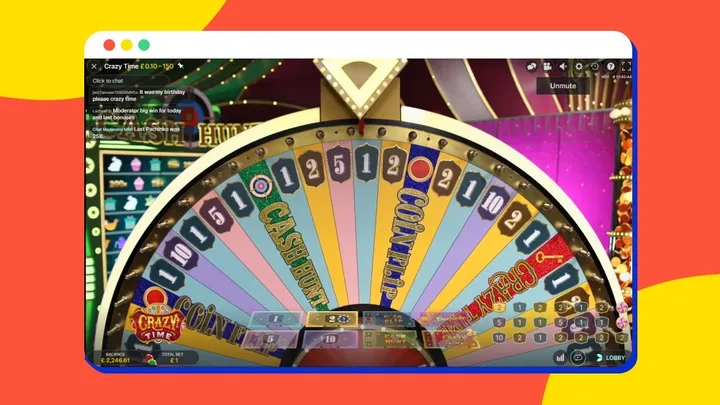
- Which bets you choose. The returns differ slightly: number 1 returns the most and Pachinko the least, less than 2 percentage points apart. All eight bets with odds and house edge are on the RTP page.
- How much you stake. The average loss grows with the total you stake, so smaller stakes and fewer rounds cost less. Doubling systems and Autoplay raise the total fast; how Double and Autoplay work is on the how-to-play page, and you can see how they work on the practice wheel, with play credits.
- When you stop. Set a bankroll for the session, the amount you can afford to lose, and a time limit before you start, and stop when you reach either one, whatever happened in the last few spins.
- Where you get advice. A paid channel that works from past spins has nothing more than the free records on a tracker.
If you find yourself chasing losses or betting more to win back a bad run, take a break; our responsible gambling page has ways to set limits and get support.
The segment counts, payouts and RTPs on this page are from the English Crazy Time rules published by Loto-Québec, which match the Italian rules from SNAI. Both were read on 25 October 2026. The run, streak and session figures are our calculation from them.